
Introduction
The Difference Between Artificial Intelligence vs Machine Learning vs Deep Learning is among the highly searched topics in today’s technology. AI, ML, and DL are revolutionizing the businesses and changing the way software systems work nowadays. AI, machine learning, and deep learning are the three technological terms most talked-about in the recent times.
Most beginners mistake machine learning for a synonym of artificial intelligence. Besides, some believe deep learning is another thing altogether. Actually, this mess of ideas poses no surprise. Both sides, online, either push the matter too far into technicalities or totally oversimplify it.
So, let’s keep it simple.
In this article, our aim is to differentiate AI, machine, and deep learning so that everyone can follow. We will avoid using textbook definitions. We will offer practical explanations, real-world examples, along with sharing a few personal insights.
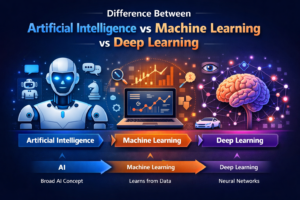 Add an image with your Focus Keyword as alt text.
What is Artificial Intelligence?
Artificial intelligence remains the driving force.
Understanding the Difference Between Artificial Intelligence vs Machine Learning vs Deep Learning becomes easier when we first understand how artificial intelligence works.
So you can imagine it is the highest-level aim: creating creatures or rather making devices behave so as to give an impression of having a mind. They don’t have to possess a mind as humans do. But they can be clever enough to, e.g., solve a problem, spot a pattern or decide.
Actually, this is what artificial intelligence is attempting to accomplish.
Still, the thing to note is that AI does not refer to one single technology. It is the general expression that stands for different approaches. Some systems are using rule-based logic, others have statistics underpinning them, and many are based on machine learning.
To give you an idea:
Voice assistants like Siri or Alexa
Website chatbots
Netflix recommendation engines
Bank fraud detection mechanisms
All the above examples are from the field of artificial intelligence.
However, this is exactly the moment when an average person gets puzzled.
Just being an AI does not necessarily mean that the particular system is machine-learning based. Traditional AI systems worked fully on rules given by programmers. If this happens, then that happens. Things were quite fixed.
Machine learning turned everything upside down.
What is Machine Learning?
Machine learning is an essential component of AI.
Machine learning plays a central role in the Difference Between Artificial Intelligence vs Machine Learning vs Deep Learning, because it allows systems to learn from data instead of following fixed rules. Instead of developing each rule by hand, developers use data as a means of teaching the system.
The system learns to recognize patterns in that data and as a result makes better guesses.
That, basically, is machine learning.
For instance, spam filtering
Only a few people would try to come up with a set of rules to cover spam in email. What is done now is the machine learning model is fed with a large number of emails and figures out what makes a spam different from a regular one.
Besides, the more one feeds the system with data, the more it usually learns.
Here is what machine learning excels at:
Recommending products
Detecting fraud
Making predictions
Web searching
Automating marketing
In fact, almost every new tech platform features AI and machine learning, in one way or another.
However, yet another layer of machine learning is the focus of a great deal of interest these days:
Deep learning.
What is Deep Learning?
Deep learning is a special kind of machine learning.
Deep learning represents the most advanced stage in the Difference Between Artificial Intelligence vs Machine Learning vs Deep Learning hierarchy. Instead of relying on traditional algorithms, deep learning uses artificial neural networks inspired by the human brain. These networks have multiple layers that process information step by step.
That’s where the “deep” in deep learning comes from. More layers.
Now let’s take a second to see the reality.
Deep learning sounds fancy, and sometimes people treat it like magic. But it’s not magic. It only works well when you have large datasets and strong computing power.
Where deep learning works best:
Image recognition
Speech recognition
Autonomous vehicles
Language translation
AI image generators
If you’ve used tools that create images from text or convert speech to text, chances are deep learning is going on behind the scenes.
In short:
Machine learning can work with a small amount of data.
Deep learning typically requires a lot of data.
Difference Between Artificial Intelligence vs Machine Learning vs Deep Learning
This is where things finally become clear.
The easiest way to understand the difference between artificial intelligence and machine learning and deep learning is to look at their relationship.
Artificial intelligence is a broad field.
Machine learning is a method within it.
Deep learning is a specific method within machine learning.
Think of it like this:
Technology
→ Artificial Intelligence
→ Machine Learning
→ Deep Learning
Simple hierarchy.
But let’s make it even clearer with a comparison.
Comparison Between Artificial Intelligence, Machine Learning and Deep Learning
| Feature | Artificial Intelligence | Machine Learning | Deep Learning |
|---|---|---|---|
| Scope | Broad concept | Subset of AI | Subset of ML |
| Goal | Simulate human intelligence | Learn from data | Learn complex patterns |
| Data requirement | Medium | High | Very high |
| Algorithms | Rules, logic, ML | Statistical models | Neural networks |
| Examples | Chatbots, robotics | Recommendation systems | Image recognition |
Most businesses today don’t build full AI systems from scratch.
They use machine learning and deep learning models to power specific features.
Machine Learning vs Deep Learning
People often ask specifically about machine learning versus deep learning.
There’s a practical difference here.
Machine learning performs best when the data is structured and puts in a manageable frame. For instance, customer churn prediction or sales number forecasting.
Deep learning is useful when the data is messy or unstructured.
Images.
Audio.
Video.
Human language.
These types of problems are very difficult for traditional machine learning algorithms.
That’s why things like facial recognition and speech assistants rely heavily on deep learning models.
Another honest thing:
Deep learning provides great results but at a very high consumption of resources. It needs usage of powerful GPUs and large datasets for training. That was one of the reasons why only big tech companies were able to rule this field for a long time.
Now, cloud platforms make it easier, but they’re not always the best solution.
Sometimes simple machine learning works perfectly well.
Real-World Applications of AI, Machine Learning and Deep Learning
Let’s move away from theory for a second.
These examples clearly demonstrate the Difference Between Artificial Intelligence vs Machine Learning vs Deep Learning in real-world applications.
Where are these technologies actually used?
Artificial Intelligence
virtual assistants
robotics
smart home systems
intelligent search engines
Machine Learning
product recommendations
spam detection
credit scoring
marketing personalization
Deep Learning
self-driving cars
facial recognition
medical imaging analysis
AI image generators
The interesting thing is that many modern products combine all three layers.
A single AI app might use machine learning for recommendations and deep learning for image recognition.
Why This Difference Actually Matters
Some folks think this debate is just theoretical, academic.
Actually, the opposite is true.
Knowing what differentiates these technologies, enables a company to opt for a solution that fits the purpose. Not all issues call for deep learning. And an AI system doesn’t always have to be a machine learning one.
Sometimes the simpler ones give the best combination of speed, cost and ease of maintenance.
If you cooperate with a data team or a developer, you will get familiar with this.
Overengineering is closer to a norm than a rarity.
Conclusion
The Difference Between Artificial Intelligence vs Machine Learning vs Deep Learning becomes much simpler once you see how they fit together.
Artificial intelligence is the big concept.
Machine learning is one of the main ways to achieve it.
Deep learning is a specialized technique inside machine learning.
And despite the hype, not every problem needs the most advanced technology. Sometimes basic machine learning models deliver excellent results.
The real skill isn’t just knowing these technologies exist.
It’s knowing when to use them.
