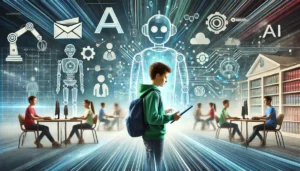
AI in Daily Life: Uses, Examples & Applications of Artificial Intelligence
Artificial Intelligence (AI) is no longer a distant futuristic technology that exists only in sci-fi movies. Today, it is a practical and real technology that is being quietly integrated into many parts of our everyday life. From smartphones and online shopping to navigation apps and healthcare systems, the presence of AI in daily life has become so natural that we often do not even notice it.
Many people still ask questions like what is AI, what is artificial intelligence, or what is AI technology. Simply put, Artificial Intelligence is a technology that allows machines to think, learn, and make decisions in a human-like way. AI in daily life is growing faster than ever, and these real life applications of AI clearly show how artificial intelligence in everyday life is becoming normal. AI in everyday life is expanding rapidly, and the examples of AI in daily life prove how deeply artificial intelligence technology is shaping the modern world.
In this post, we will explore AI information, its real-world uses, benefits, and practical examples. We will also explain how AI is being used across different industries in a simple and easy-to-understand way.
What is AI (What is Artificial Intelligence)?
AI or Artificial Intelligence is a fundamental field of computer science that deals with the design and creation of intelligent agents or machines that can perform operations that humans are capable of through their natural intelligence such as learning from experience, understanding languages, recognizing images, and even coming up with solutions.
Instead of just being given detailed commands, AI systems are made to improve their knowledge by being exposed to different data. Basically, the more data they get, the better and more precise their decisions will be.
Simply put AI:
- helps machines to think
- helps machines to learn
- helps machines to get better


That is artificial intelligence working behind the scenes when your smartphone predicts the next word while typing or when YouTube suggests videos.
AI Information: How AI Technology Operates
AI technology predominantly operates on the concept of working with huge datasets. The first step involves gathering data. Next, AI-powered systems go through this data to spot recurring patterns. Subsequently, the system learns from these patterns and utilizes them to forecast or make decisions.
It is not necessary to keep re-programming AI. After being trained, it is capable of self-optimization and thus continually getting better on its own.
Some of the main AI technologies:
- Machine Learning
- Deep Learning
- Natural Language Processing (NLP)
This capability to learn is what makes AI so amazing and powerful.
What Makes Artificial Intelligence So Important Today
The amazing thing about AI is that it is a great time saver and significantly reduces the amount of human labor needed. It is capable of performing monotonous tasks, deciphering vast troves of data, and working non-stop without any sign of weariness.
Hence, the use of artificial intelligence is rapidly becoming omnipresent both in businesses and personal lives.
Advantages of AI:
- Speeding up tasks
- A higher level of accuracy
- Automation
- Enhanced decision-making
AI in Daily Life – Real Examples
AI is present everywhere around us in our day-to-day life, whether we realize it or not. Almost every digital service that we have access to today depends on AI at some level.These examples of AI in daily life show the practical uses of AI and how AI technology examples are becoming part of normal routines.
Here are the examples below.
Smartphones and Voice Assistants
Voice assistants such as Google Assistant, Siri, and Alexa are some of the ways that use artificial intelligence to understand the speech of humans and respond in an appropriate manner.
Further, they are capable of:
- Setting alarms
- Making calls
- Sending messages
- Playing music
- Answering questions
Indeed, these are some of the simple day-to-day usages of AI that make life more convenient.

Online Shopping and Recommendations
E-commerce websites employ AI to analyze the activities you do while browsing and purchasing. Therefore, products that you may be interested in will be suggested based on this information.This is one of the best real life applications of AI where artificial intelligence solutions improve customer experience.
To illustrate, a search for headphones will prompt you to see more of the same kind of products.
Practically speaking, one of the most frequent examples of artificial intelligence in the real world is the application of face recognition technology.
Face Recognition and Security
Face recognition is a widely used tampered application of AI that mainly serves the purpose of personal identification.
You can get this in:
- Mobile phone face unlocking feature
- Employee time tracking systems in offices
- Airports for security purposes
AI technology scrutinizes human face features and compares a person’s face with existing data.
AI in Healthcare
AI in medical technology is a great helper for physicians and healthcare facilities to improve patient care services.
The following are AI medical applications:
- Identifying diseases
- Examining medical images and scans
- Virtual health aides
- Guessing the risk of patients
Artificial intelligence applications on these fronts not only save time but also ensure greater precision.

AI in Navigation and Transportation
GPS apps implement AI to understand the current traffic situation and provide the best routes.
Besides that, AIs are used in:
- Carpooling services
- City traffic control systems
- Driverless vehicles
All three combine to illustrate that AI technology is revolutionizing transport.
AI in Banking and Finance
Banks employ AI for:
- Monitoring and detecting frauds
- Using chatbots for client conversation management
- Handling issues related to lending
- Managing the credit rating process
Such artificial intelligence applications are the ones that contribute to making banking easier and safer.
AI in Education
Platforms designed for AI learning can change the course of education through non-lectured plans.
Their role extends to:
- Adaptation of study programs to individual needs
- Student helpers in the form of digital tutors
- Inventions of quizzes that challenge the intellect
- Automatization of the grading process
Education in our time is greatly benefiting from the integration of AI.
Applications of Artificial Intelligence Across Industries
AI is not a exclusive domain of one diverse industry. It is utilized in:
- Healthcare
- Retail
- Education
- Farming
- Factories
- Marketing
- Finance
Hence, when a person wants to know what are the applications of artificial intelligence, the answer is straightforward: almost every industry.

Uses of AI in Daily Life
The majority of people in the world frequently use the following AI applications:
- Voice assistants
- Recommendation systems
- Navigation apps
- Spam filters
- Face recognition
- Chatbots
- Smart home devices
We use these tools every day without even realizing it.
Advantages of Artificial Intelligence
Some of the benefits that artificial intelligence bring to us are:
- Saves a lot of time
- Minimizes mistakes
- Boosts productivity
- Works around the clock
- Processes large volumes of data
That is the very reason why users of artificial intelligence keep increasing.
Challenges of AI
AI also has some challenges:
- Privacy of data issues
- Cost of development is quite high
- Unemployment due to machines
We can control and handle these issues
Frequently Asked Questions (FAQs)
1. What are the main uses of AI?
The main uses of AI are automating tasks, analyzing data, enabling recommendation systems, fortifying security, diagnosing healthcare problems, virtual assisting and personalized learning experiences. These uses, in fact, have greatly increased effectiveness and precision across a variety of sectors.
2. What are the applications of artificial intelligence?
You will find artificial intelligence being used in health, education, finance, sales, agriculture, transport and industry. As a matter of fact, most modern industries now employ artificial intelligence technology.
3. What is the future of AI in daily life?
There are a lot of opportunities and very positive possibilities for the role that AI can play in our everyday lives. It is going to be more and more common to see luxury living spaces being run by smart technology, help and interaction with highly intelligent robots, AI physicians, and driverless cars. The integrating of AI into human life is a process that will never cease to constantly evolve.
4. What is AI technology and how does it work?
To put it simply, a major part of AI technology is based on going through the data over and over until it spot the patterns it makes. Apart from absorbing knowledge from human programming, artificial intelligence systems can enhance themselves through machine learning, and deep learning, which, in effect, makes human re-programming unnecessary.
5. What are the benefits of artificial intelligence?
There are endless ways in which artificial intelligence might benefit society, to name a few, upgrading the accuracy of the results, automating tasks that are boring and monotonous, and speeding up the processes. Besides, AI solutions are not only good for enterprises; they are also useful to individuals as they work for 24/7 and enhance productivity.
6. Will AI replace human jobs?
Yes, AI can certainly replace human jobs that are very repetitive but at the same time it is a source of new jobs. The chief operation of Artificial Intelligence is to relieve humans from the drudgery of the routine tasks so that subsequently people can engage themselves in the creative and strategic facets of work.
7. What are some examples of AI in daily life?
Some examples of AI in daily life include voice assistants, face recognition, recommendation systems, navigation apps, chatbots, spam filters, and smart home devices.