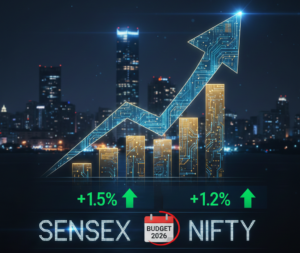
Why Sensex and Nifty are rising ahead of Budget is a common question among investors as the Indian stock market turns positive before the Union Budget. The Indian stock market is always buzzing when the Union Budget is just a few days away. Investors, traders, and even beginners become very interested in the daily market movements. We have noticed Sensex and Nifty closing higher lately, and one of the major reasons behind this good mood is the Economic Survey released by the government. Many analysts explain that why Sensex and Nifty are rising ahead of Budget is closely linked to the positive Economic Survey and strong growth expectations.
So what does it really mean?
- Why
- are Sensex and Nifty going up?
- What role does the Economic Survey play?
- How is the upcoming Budget affecting the market?
Let’s dissect these questions with simple and straightforward explanations.
What Does Economic Survey Mean?
The Economic Survey is a report published annually by the Government of India just before the Union Budget. It includes a comprehensive analysis of:
- India’s economy
- GDP growth forecast
- Price level changes
- Job situation
- Industries and sectors performance
Simply put, Economic Survey is similar to India’s economic report card.
When it indicates that economy is growing and stable, it raises investors’ confidence in the future. And confident investors buy stocks, which drive the market higher.
How Economic Survey Makes Market Feeling Better
The current Economic Survey has painted a mostly bright picture of the Indian economy. It indicates that:
- Growth in economy is still strong
- Demand from consumers remains strong
- Government is managing its finances well
Investors interpret the above points as Indian companies will continue to be profitable in the next quarters which leads to increased buying activity in the stock market.
The above optimistic vibe from the market is one of the major reasons why Sensex and Nifty have been going up.
Why Sensex and Nifty Are Going Up Before Budget
We have analyzed the main reasons one by one.
1. Why Sensex and Nifty Are Rising Ahead of Budget for Investors
Investors will expect that companies will reap higher profits in the future when they assume that the economy will continue to grow at a good pace.
Profits that are higher generally result in:
- Stocks being valued higher
- More investors getting interested
- Share prices going up
The Economic Survey has given more weight to this investor’s persuasion, which is helping pull up the market in general.
2. Hope for a Budget That Will Accelerate Growth
This clearly shows why Sensex and Nifty are rising ahead of Budget and why investors are positioning themselves early. In times of a pre-Budget season, investors always try to predict what the government might announce. The major findings of their expectations look like this:
- More infrastructural development
- Manufacturing and MSMEs getting support
- Green energy and startups getting incentives
A Budget that aims at growth would see many sectors benefiting. Because of these anticipations, investors start buying stocks early, thus, positioning themselves.
Such early buying is the main reason for the rise in Sensex and Nifty.
3. Positive Performance of the Banking and Financial Stocks
Banking and financial companies constitute a major part of both Sensex and Nifty. When bank shares go up, generally the overall index follows.
When economy is growing:
- People get more loans
- Companies increase their business
- Banks make more from interest
The good economic forecast has boosted the confidence in banks stocks, thus, providing support to the market.
4. Improvement in Foreign Investor Sentiment
Foreign Institutional Investors (FIIs) are crucial players in the Indian markets. It is only when they are assured of India’s economic potential that they pump more capital here.
A positive Economic Survey is a powerful tool to communicate to the global investors that:
- India is still a robust economy with good growth prospects
- There are attractive long-term opportunities
Sometimes just a small rise in foreign investments is enough to take markets to new highs.
5. Growing Participation of Retail Investors
Over the last few years, more and more Indian families have exposed themselves to the stock market and mutual funds for their investment needs. A large part of the investors now use SIPs and online trading platforms as their tools.
Positive news often leads to:
- Retail investors not only continuing but also increasing their investments
- Markets enjoy a steady inflow of cash and
Such consistent participation ultimately becomes a very strong factor for the upward trend.
Role of Budget Expectations in Market Rally
The Union Budget is about more than just numbers; it portrays the government’s developmental outlook for the economy.
Some common expectations from the upcoming Budget include:
- Offering some relief for middle-class taxpayers
- Capital expenditure going up
- Greater emphasis on digital economy and technology
- Creating employment essential for the economy
Before the events, the market attempts to “price in” these expectations. In other words, the share prices may get uplifted beforehand reflecting what investors foresee.
Which Sectors Are Benefiting the Most?
Certain sectors are more likely to get the benefit of Budget euphoria than others.
Infrastructure
Enterprises doing the road, railway, housing, and urban development work generally see their shares going up when government disbursements for these sectors are on the cards.
Banking and Finance
More economic activities mean more disbursal and deposits, which are supportive of bank earnings.
Manufacturing
Besides this, government schemes for import substitution also enable the manufacturing sector to expand its business.
Energy and Green Technology
Businesses related to renewable energy, electric cars, and other sustainability measures are being watched closely prior to any government announcements.
Is This Market Rise Sustainable?
The present uptrend is mainly based on anticipation.
It can go on if only:
- Budget announcements fulfill or surpass market expectations
- There is sustained good economic growth
On the contrary, market corrections can happen if:
- Budget is a disappointment
- There are adverse developments globally
Hence, although the trend is up, a few hiccups here and there are only natural.
What Should Investors Do Right Now?
Here is a list of things to do to keep your sanity intact:
1. Avoid Emotional Decisions
Don’t get caught in the uptrend frenzy and overinvest in stocks
2. Focus on Fundamentals
Identify companies with healthy financials, experienced leadership, and a proven track record.
3. Think Long-Term
Day-to-day changes in the market aren’t as significant as the overall trajectory over the years.
4. Diversify Your Investments
Don’t splurge all your savings on a single stock or a particular industry.
5. Continue SIPs
Systematic Investment Plans are the savviest way to curb the impact of market volatility.
Simple Advice for Beginners
If you are new to investing:
- Go for index funds or blue-chip stocks initially
- Understand the basic concepts before buying shares
- Don’t take advice from social media or suspicious sources
Being patient and keeping a steady hand is the best way to grow your money over time.
Common Mistakes to Avoid
- Buying hot stocks based solely on tips
- Trying to time the market by panic-selling during small drops
- Having unrealistic expectations of profits
The stock market operates on the principle of discipline rather than luck.
Final Thoughts
Leading market indices Sensex and Nifty are gaining ground in anticipation of the Budget mostly because of:
- A positive Economic Survey
- Very strong growth expectations
- The hope of a pro-development Budget
- Investor confidence getting a big boost
This reflects the faith of the market players in India’s growth over the long term.
Now you clearly understand why Sensex and Nifty are rising ahead of Budget and what it means for your investments Nevertheless, knowledgeable investors are aware of the cyclic nature of markets. They prefer to concentrate on their long-term objectives and good investment habits rather than reacting to every news item.
When you make your investments with a combination of patience, research, and discipline, the fluctuations in the short term may turn into chances for you, not risks.