Digital Marketing or Traditional Marketing: Which Is Better for Small Businesses?
Digital marketing vs traditional marketing is one of the most important decisions small business owners face today. Low budgets and high competition mean that choosing the right marketing tactics can have a direct impact on business growth, leads and sales. In this article, we’ll directly compare digital marketing and traditional marketing to help small businesses figure out the best path to ROI, results, and success. We’ve come to the time when small businesses must make a very important decision – whether to spend their money on digital marketing or stay with traditional marketing while planning for their growth. Both ways have their advantages and the point is – what works best for small businesses that only have a limited budget?
This is just a plain and simple comparison between traditional marketing and digital marketing. We also look at how expensive they are, whether or not they can reach your audience, their effectiveness and what kind of ROI you should expect to get, so you can make the best decision for YOUR business.
Digital Marketing Demystified
Digitally marketing means using the internet and various digital channels to promote one’s goods or services. It can be through search engines, social networking sites, e-mail, websites, or even placing paid ads online.
Different from the traditional ones, digital marketing is a flexible way for companies to establish a relationship with their potential customers, monitor their campaign effectiveness at the same time, and make adjustments to their campaigns accordingly.
Typical Digital Marketing Platforms
- SEO (Search Engine Optimization)
- Google Ads and Other Paid Searches
- Social Media Marketing (FB, Instagram, LinkedIn)
- Email Marketing
- Content Marketing & Blogging
- WhatsApp & Messenger Marketing
What’s more, digital marketing has the ability to give small enterprises the most extensive exposure at the least possible cost.
Traditional Marketing Scenarios
Where traditional marketing is concerned, it takes advantage of those time-tested offline promotional methods that are familiar to most people. At the same time, such techniques primarily focus on reaching a large number of people and not on ones personally targeted
The list of examples is newspapers, radio, television, flyers, hoardings, magazines, and direct mail.
Traditional marketing is a great local brand awareness tool but it doesn’t offer precision, performance tracking, and cost-effectiveness – features that small businesses find highly challenging.
Typical Traditional Marketing Channels
- Advertisements in the newspaper
- TV commercial
- Radio ads
- Outdoor advertising
- Leaflets and pamphlets
- Magazine ads
Digital Marketing vs Traditional Marketing: The Most Important Factors
1. Cost & Budget Flexibility
Small businesses are always working under a lot of constraints. Digital marketing is industry offering a low-cost entry point, allowing for flexible spending, and a possibility for scalable campaigns. Traditional marketing generally comes with high upfront costs and no certainty of results.
2. Target Audience Reach
One of the great benefits of digital marketing is that it targets only those people who are most likely to be interested, based on various criteria such as geographical location, age, and lifestyle, etc. When using traditional marketing, the message gets disseminated to a very wide audience most of which won’t be interested anyway.
3. Measurability & Tracking
Digital marketing’s strongest feature is that it enables marketers to track the performance accurately and make the necessary adjustments on the fly. On the other hand, traditional marketing doesn’t have reliable data coming from it, therefore, it is hard to figure out if the investment paid off.
4. Speed & Results
Creating a buzz for a brand through digital means is a matter of hours while traditional marketing takes weeks or months before any impact can be seen.
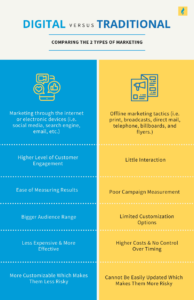
Comparison Table: Digital Marketing vs Traditional Marketing
| Feature | Digital Marketing | Traditional Marketing |
|---|---|---|
| Cost | Budget-friendly & scalable | Expensive upfront |
| Targeting | Highly specific & data-driven | Broad & general |
| Performance Tracking | Real-time analytics | Difficult to measure |
| Customer Interaction | Two-way communication | One-way communication |
| Speed of Results | Fast & flexible | Slow |
| Best For | Small & growing businesses | Large brands |
ROI Comparison for Small Businesses
| Factor | Digital Marketing | Traditional Marketing |
|---|---|---|
| Lead Cost | Low | High |
| Conversion Rate | Higher | Lower |
| Optimization | Instant changes possible | No flexibility |
| Return on Investment | Measurable & high | Uncertain |
Why Digital Marketing Is Considered To Be An Advantage For Small Businesses?
Working with a digital marketing strategy small businesses are given a chance to go head to head with bigger brands even though they are not able to spend as much money. You know – start on a small scale; test the waters; keep a close eye on the data and then expand what works.
Just some of the reasons why it’s a win include:
- Better visibility on Google
- Direct contact with customers
- Local and international reach
- Measured growth
- Higher conversion rates
After all, digital marketing still offers small businesses the ability to acquire long-term online assets such as websites, blogs, or social media platforms.
Cases When Traditional Marketing Still Has Its Place
Peer advertising hasn’t lost all its” charm”. It is still is a matter of “when” rather than of “if” such as:
- When your audience is not very tech-savvy
- Your business is limited to a very local area (small towns, rural areas)
- You are going for a brand recognition in the offline environment
Final Verdict: Which One Should You Choose?
The answer is almost a no-brainer Digital marketing is the way to go for most small companies. Besides being cheap, it is also a measurable, flexible, and fast-paced channel.
Having said that, the best approach is frequently a clever blend — digital marketing as the primary growth engine with a little traditional marketing for the times when it’s really needed.
Simple Recommendation:
- New or small business → Digital Marketing
- Established local brand → Digital + Limited Traditional
Key Takeaways
- Digital marketing yields higher ROI to small firms
- Traditional marketing is costly and hard to track
- Online marketing offers better targeting and quicker scaling
- One big method is fine, but digital should definitely be the lead
Frequently asked questions (FAQs)
1.What are the key differences between digital marketing and traditional marketing?
Ultimately the two only differ in their platform and tactics. Digital marketing is the use of online channels, namely search engines, social media and websites, whereas analog marketing consists of offline activities like newspapers, TV’s radio, etc. Digital marketing is, however, more benefiting small businesses with a lotof tricks and additions when it comes to targeting, tracking and budgeting features hence making it more efficient.
2.What is the cheaper marketing way for small businesses?
There is no doubt about it: digital marketing/online marketing is affordable and an inexpensive way for small businesses to reach the right audience. You can always begin small and expand as you succeed. However, traditional advertising needs a big sum of money to be paid upfront that small or newly established businesses are not capable of doing.
3. Can small businesses utilize both digital and traditional marketing?
Combining both strategies is not only possible but also a good idea for the small businesses. Digital marketing will be the primary focus and through traditional marketing brand awareness will be created on the local level. Briefly speaking, the best answer is a balanced one but with digital marketing holding the majority of marketing activities.
4. Is local business digital marketing effective?
Absolutely! Local business can, among other things, use the great advantage of digital marketing tools such as local SEO, Google Business Profile, social media ads, and WhatsApp marketing. Businesses can take advantage of these ways to establish a good relation with their local customers who, actually, are the ones already looking for the kind of services they offer.
5. How soon can digital marketing efforts bring about results?
Paid advertising which is just one of the digital marketing tactics might bring you results in a few hours or days. On the other hand, SEO and content marketing need a lot of time and work to make their effect visible.