The Strategic Choice: Static vs. Dynamic Architecture for Modern Business Websites
Introduction
The Strategic Choice: Static vs. Dynamic Architecture for Modern Business Websites is no longer a purely technical debate—it is a critical business decision that directly impacts performance, scalability, SEO, and user experience.. One consistently loads in a flash, is user-friendly, and is pretty reliable. The second is visually appealing, constantly updates its content, and offers personalized experiences. After six months, both CEOs wonder if they made the right call on their website architecture.
At that point, choosing between a static or dynamic website architecture for your business becomes way beyond a mere technical issue. It is a business decision, which directly affects performance, scalability, SEO, user experience, and consequently, your growth. The wrong choice can drag you down. The right one can be your silent partner in success.
The Strategic Choice: Static vs. Dynamic Architecture for Modern Business Websites – Final Thoughts
The Basic Question: What Is Website Architecture?
Website architecture is a term describing how your website is constructed, organized, and ultimately experienced by users. It outlines the whole life cycle of the content from creation to storage and display when a user opens your website.
For businesses today, the architecture of a website encompasses more than just aesthetics or code. It plays a crucial part in determining the speed, security, flexibility of the site, and the scalability potential i.e., how easily the site can grow. The architecture decision is your first strategic step, regardless of whether you are a fledgling startup, an agency, or a well-known brand.
Getting to Know Static Website Architecture
How to Define a Static Website?
A static website is an unchangeable set of files – HTML, CSS, and JavaScript – that are by and large instantly served to the users’ browser. If the owner does not update the site, all users will get the same content.
Understanding of the Mechanism
Static websites do not use databases or server-side processing. The web pages are generated in advance and are served exactly in the same form as they are stored, which explains why they are very light and fast.
What Are the Benefits of a Static Website?
- It performs at lightning speed due to the very limited need for processing
- It is very secure as there are hardly any entry points
- It comes with low development and hosting costs
- It is suitable mainly for small sites and thus, easy to maintain
This suite of features makes static websites a viable option for those prioritizing speed and a high degree of reliability.
Disadvantages of Static Website Architecture
- Content changes can only be done manually
- There is no automatic customisation
- Functionality is constrained without third-party tools
Use Cases
Static websites are best suited for:
- Artist and personal branding
- Pages for launching products and campaigns
- Local companies with a small amount of updates
- Educational websites
If the content hardly changes, you get great value from a static architecture.
Familiarization with Dynamic Website Architecture
What Is the Meaning of a Dynamic Website?
A dynamic website creates content during interaction using a database and program logic on the server side. Therefore, depending on different factors such as input, preferences, or data updates, what the visitors see can vary.
Understanding of the Mechanism
Dynamic websites fetch their content from databases with the help of backend technologies. WordPress-based websites are widely acknowledged as a perfect example of dynamic web architecture in enterprise website development.
The Service of Databases and CMS
The content is saved in databases while a CMS enables the non-technical people to make changes on pages, blogs, products, users, etc., without the need to write the code.
What Are the Benefits of a Dynamic Website?
- Linear growth of the business can be accommodated easily
- Users get personalized experiences
- There is automation and integration
- Content can be updated easily without any hassle
Dynamic websites are more flexible as compared to static websites.
Weaknesses of Dynamic Website Architecture
- Performance could drop in case of non-optimization
- Higher costs for buying, developing, and maintaining
- Greater security concerns
Best Use Cases
Dynamic websites are suitable for:
- Online shopping sites
- Blogs and information-rich websites
- SaaS tools
- Corporate-level solutions
If your business evolves frequently, dynamic architecture provides room to grow.
Static vs Dynamic Websites: A Strategic Comparison
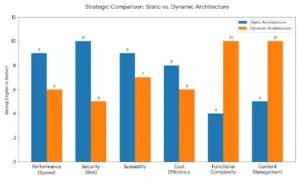
Comparing static websites vs dynamic websites, one finds that the biggest difference is basically in performance versus flexibility.
Performance
- Static web pages are delivered to the browser instantly as they are simple HTML files and don’t require interaction with the server or database. Thus they usually load faster.
- Dynamic web pages need to communicate with the server for each request. The server must execute some processing and afterwards, a response is sent, which in some cases may mean slower loading times.
Scalability
- Static sites handle traffic very well as they can be cached easily, but they are limited in adding new content.
- Dynamic sites can grow both in traffic and features as they can change content based on the visitor and offer various interactions.
Cost
- A static architecture usually costs less to build and run.
- A dynamic architecture could be more expensive since it needs updating and revision.
Security
- Static websites have less attack surface therefore less security risks.
- Dynamic websites are more exposed to security vulnerabilities that need to be fixed through patches and upgrades.
Maintenance
- Static sites require direct edits for every change
- CMS-based sites are more convenient for regularly updating and managing content
SEO Impact
- Static websites are perfect for SEO strategies targeting website loading speed.
- Dynamic websites are a better fit for content-focused SEO strategies that can keep updating the content.
Different factors might support different types of websites, so ultimately it depends on what you aim to do with the website.
Which Architecture Is Right for Your Business?
Making a right decision about the web architecture may be done when the picture is clear. You may ask yourself these questions:
- How often will the content be changed?
- Do you require personalization or automation?
- What is your present and future budget?
- How fast do you expect to expand?
Choose Static Architecture If:
- If your content is mainly static
- If your foremost focus is on speed and security
- If you want a simple and cheap solution
Choose Dynamic Architecture If:
- If you regularly update your website
- If you want your website to be not only scalable but also dynamic
- You prioritize user experience and you want the experience to be personalized
Making a strategic decision does not mean choosing the most fashionable thing but the one that suits your business goals.
Future Trends in Website Architecture
Web architecture is already trending towards a comprehensive solution, not merely a static vs dynamic one.
Headless CMS
If you separate content from the presentation without a headless CMS, you can be limited to one platform only, however, with headless CMS, you are free to use multiple platforms while still getting high performance.
Jamstack
Jamstack unites the best of the static performance with the dynamic features. This way the site is not only fast but also flexible.
Hybrid Architectures
Today, it is very common for companies to use static frontend technology combined with a dynamic backend.
Performance-First Development
Performance is going to be one of the major ranking factors down the line. This is why a future-proof architecture is one that takes into account performance, accessibility, and user experience right at the start.
Final Conclusion
The Strategic Choice: Static vs. Dynamic Architecture for Modern Business Websites doesn’t mean a technical feature list but a decision that a company will eventually make from the business point of view. Static websites mean speed, simplicity, and security. Dynamic websites mean flexibility, scalability, and control.
The most successful companies stay a few steps ahead of the trends. They pick an architecture that fits their vision, their budget, and their growth plan. When the website’s foundation is in tune with the strategy, everything else – from SEO to conversions – becomes a natural consequence.